
Full Back
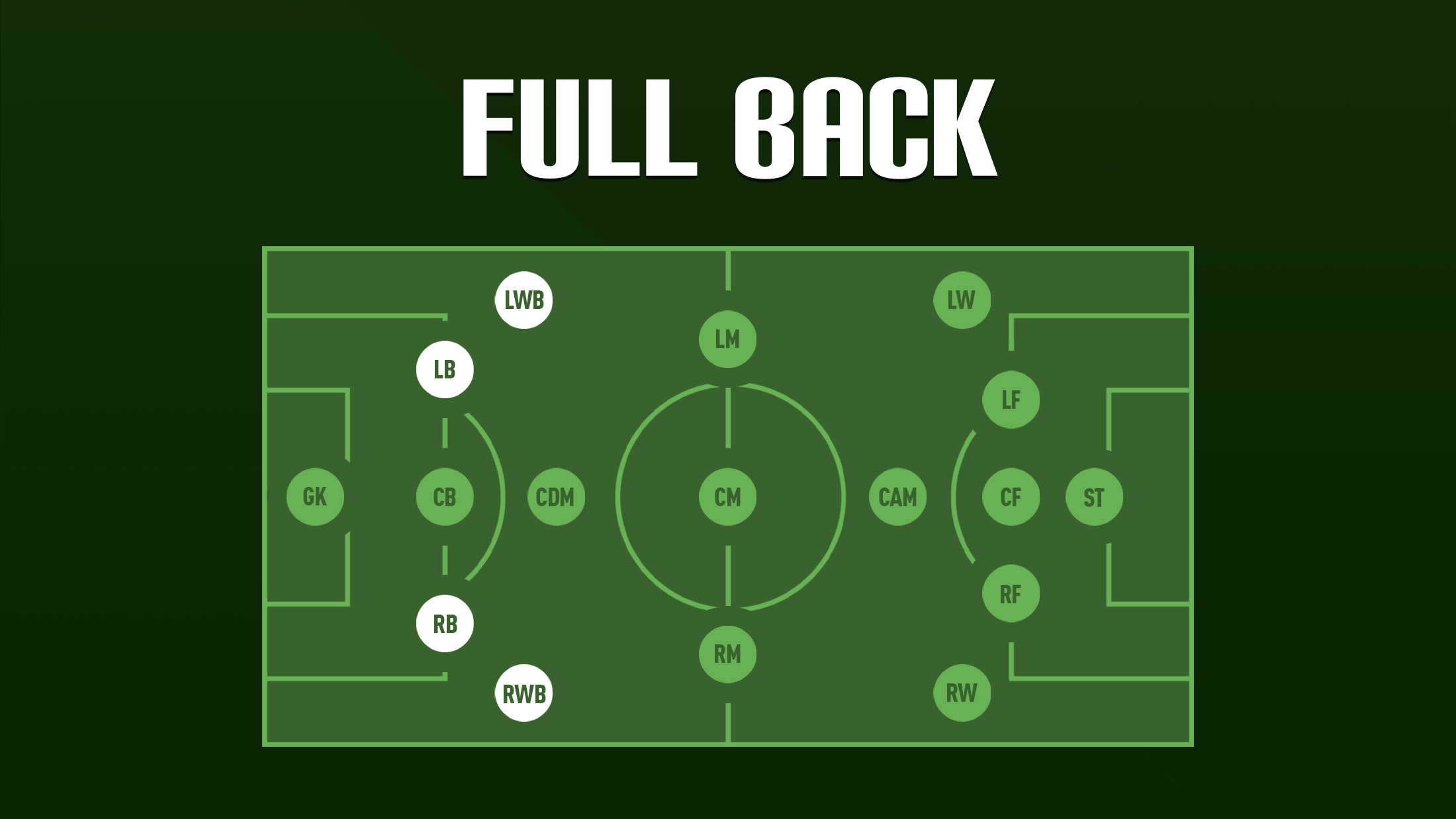
A full back (fullback) in football is a defensive player positioned on either side of the back line, primarily responsible for stopping opposition wingers, protecting the flanks, and supporting attacking plays down the wide areas. Traditionally seen as purely defensive, the modern full-back has evolved into one of the most dynamic and tactically complex roles on the pitch. They must combine defensive reliability with attacking contribution, making overlapping runs, delivering crosses, and often participating in build-up play from deep positions.
The full-back’s role demands constant movement, tactical discipline, and excellent stamina. Whether playing in a back four or as part of a wing-back system, they operate along the entire flank, balancing defensive structure with attacking freedom. In modern football, full-backs are vital to transitions, width, and pressing systems.
Defensive Responsibilities
A full-back's primary duty remains defending the wide channels. They must mark wingers closely, block crosses, and support center-backs in covering spaces during counter-attacks. Good positioning allows them to stay compact with the back line while still being able to step out and press. Timing is crucial, stepping forward too early leaves gaps, while staying too deep gives wingers space to cross or shoot. Anticipation, awareness, and 1v1 defending skills define consistency in this role.
Key Attributes and Skills
Full-backs require a rare mix of athleticism, technique, and tactical awareness. They must sprint, recover, and deliver quality passes repeatedly over ninety minutes while staying disciplined in defensive duties. Awareness of space, timing of runs, and decision-making under pressure are crucial. A complete full-back must know when to defend deep, when to press, and when to join attacks without leaving the defense exposed.
- Stamina and recovery speed
- Acceleration and agility
- 1v1 defending and tackling
- Crossing accuracy and timing
- Positioning and defensive awareness
- Communication and coordination with center-backs
- First touch and ball control
- Passing range and composure in buildup
- Tactical discipline and anticipation
- Work rate and mental focus
Types of Full-backs
There are several distinct types of full-backs in modern football, each shaped by tactical systems and player attributes. The traditional full-back focuses mainly on defense, staying deeper and prioritizing marking, tackling, and positional discipline. The attacking full-back emphasizes forward runs, overlapping movements, and crossing to create scoring opportunities. Inverted full-backs, popularized in possession-heavy systems, drift inside to form midfield overloads and aid in ball circulation. Finally, the hybrid full-back can switch between overlapping and inverting roles based on the match context, showcasing tactical intelligence and adaptability.
Right-backs and Left-backs
Full-backs are divided into two positions on the defensive line: the right-back (RB) and the left-back (LB). The right-back operates on the right flank, often favoring their stronger right foot for crosses and clearances, while the left-back mirrors these duties on the opposite side. Both share identical core responsibilities but may differ slightly based on tactical instructions or player profiles. For example, a left-footed left-back like Andrew Robertson provides natural width and crossing ability, whereas an inverted right-back such as João Cancelo drifts centrally to support possession and midfield play. These positional nuances allow teams to balance defensive solidity with creative flexibility.
Positioning and Movement
Positioning defines a full-back’s success. Out of possession, they maintain shape with the defensive line, staying compact while tracking runners. In possession, they push forward when the winger cuts inside or stay deeper to recycle play and protect against counters. Movement must be coordinated with the winger or wide midfielder to avoid leaving space behind. Intelligent positioning allows the full-back to offer passing options while maintaining defensive security.
Attacking Contributions
Modern full-backs play a huge part in attack. They overlap wide forwards to create numerical advantages, stretch the opposition’s defensive line, and deliver accurate crosses into the box. Some systems also use inverted full-backs who drift into central midfield during possession, helping to control buildup and protect transitions. The attacking full-back is expected to combine pace, composure, and technical ability to contribute assists and maintain team width.
Tactical Role in Modern Football
In contemporary tactics, full-backs adapt depending on system and coach philosophy. In a 4-3-3 or 4-2-3-1, they provide width and attacking overlap. In a 3-5-2, they play as wing-backs, covering the entire flank both defensively and offensively. Under modern coaches, full-backs often move into midfield (“inverted full-backs”) to assist in build-up play, protect possession, and press centrally when the ball is lost. The evolution of the role reflects football’s shift toward fluid and multi-functional player profiles.
Full-back vs Wing-back
Although similar, a full-back and a wing-back differ mainly in positioning and responsibility. A full-back plays deeper in a back four, focusing more on defense and controlled overlapping runs. A wing-back, used in a back three system, plays higher up the pitch and carries greater attacking responsibility. The wing-back must still defend wide areas but often serves as a key source of width in attacking phases.
Importance in Team Tactics
In modern football, full-backs are often the team’s primary outlets for width and progression. Their decisions shape transitions, pressing triggers, and attacking flow. Effective full-backs allow wingers to cut inside, enable overloads in midfield, and stretch compact defenses. Their contribution goes far beyond defending, today, the full-back is one of the most tactically influential positions in the game.
Famous Modern Full-backs
The rise of attacking full-backs has redefined football tactics in recent years. Players such as Trent Alexander-Arnold, João Cancelo, Andrew Robertson, Kyle Walker, and Alphonso Davies have become examples of the modern, multi-dimensional full-back, capable of influencing both defense and attack. Earlier generations featured icons like Cafu, Roberto Carlos, and Paolo Maldini, whose intelligence and stamina set the foundation for today’s evolution of the position.